Visual Fault Locator K-V30
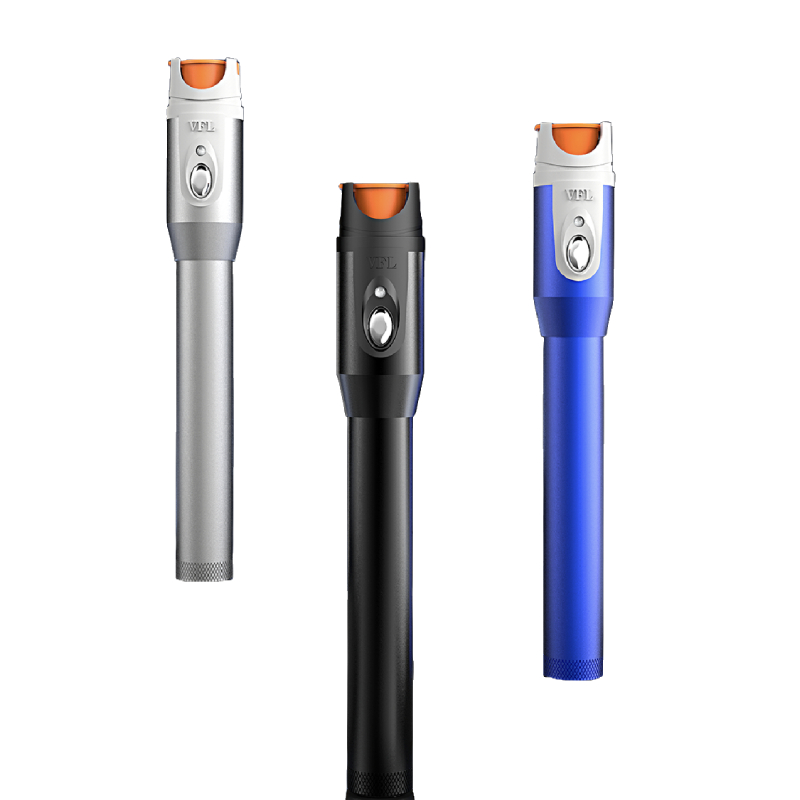
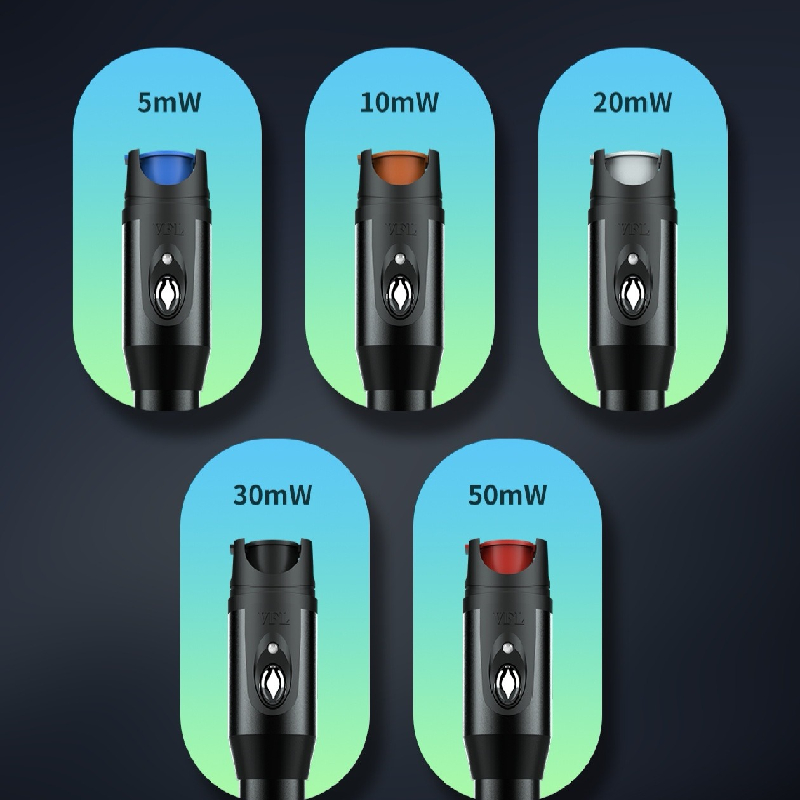
A 50 g aluminum pen that makes the fault glow: five output powers from 5 mW to 50 mW at 650 nm, one button for CW and blink, and a 2.5 mm universal end that takes SC, FC and ST straight in.
Typical work: Finding breaks, crushed sections and over-tight bends in patch cords and pigtails; Checking continuity before a splice or before a jumper goes into service; Identifying one fiber in a bundle by its glow at the far end; Locating faulty connectors in cabinets, closures and distribution frames; Working the OTDR dead zone: the first metres an OTDR cannot see, the VFL can.
Get a Quote Add to Kit WhatsApp UsGoing into a kit? Add this tool to your kit list and quote the whole set at once — or take it on its own, neutral or with your label.
Neutral stock in small lots, or private label made to your requirements. Prices on request — EXW factory pricing.
K-V30 key features
- Five powers, one pen: 5 mW for short patch cords and pigtails inside the cabinet, the mid powers as all-round field versions, and 30 to 50 mW for longer runs where the beam has further to travel before it can leak out at the fault — same body, same universal connector, the power is set when you order
- One button does everything: a short press turns the pen on in CW for a steady glow while you trace a cord, the next press switches to blink — a flashing fault is far easier to pick out of a crowded frame than a steady light — and the next press turns it off; no menus, no setup
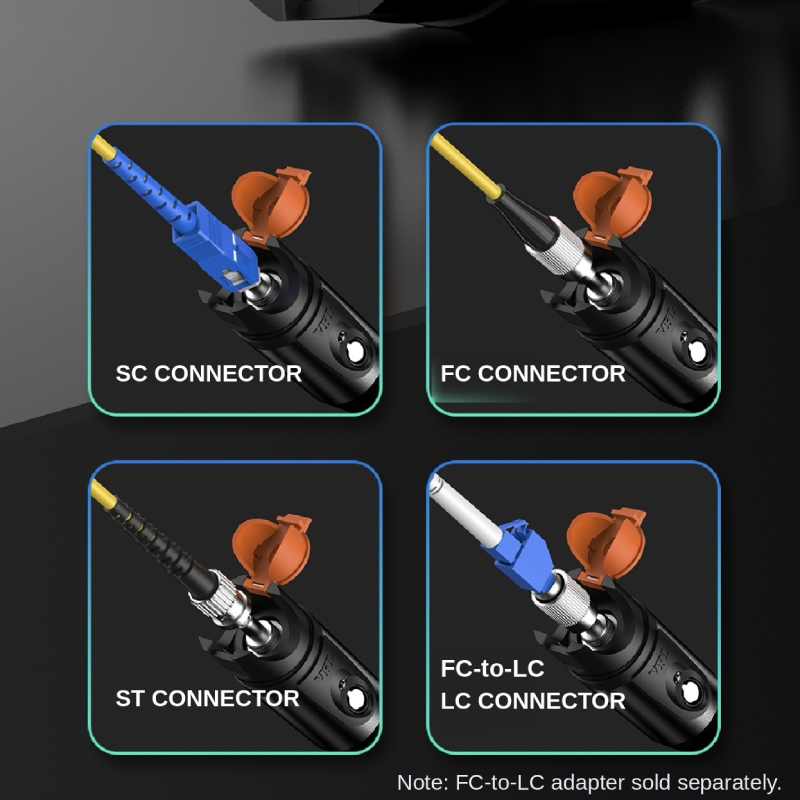
- Universal 2.5 mm connector takes FC, SC and ST ferrules directly, so the pen walks from the ODF to the floor box to the customer's ONT without swapping adapters; LC work goes through an FC-to-LC adapter, available separately
- The wear parts come off by hand: the 2.5 mm metal head and the 7 mm ceramic ferrule inside it are user-replaceable, so a worn or chipped ferrule is swapped in the field instead of retiring the whole pen — the ferrule is a wear part and sits outside the warranty, and we say so up front
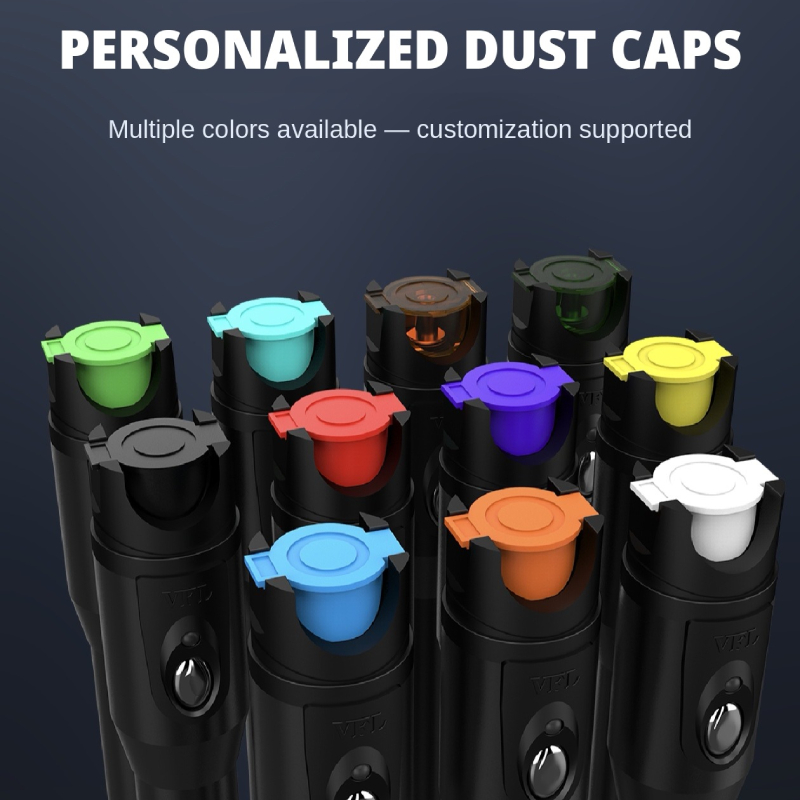
- Aluminum alloy body in silver, black or blue — non-slip in the hand, corrosion-resistant, and at 50 g light enough to live in a shirt pocket or the test slot of a tool kit; the dust caps come in a range of colors and can be made in your brand color
- Checked before it ships: the switch is tested for 100,000 presses, and every finished pen passes a fiber break test after assembly before it is packed — the unit that arrives has already found a fault on the bench
- Runs on two AA batteries — cells you can buy anywhere in the world and swap in seconds, with no charger to carry and no built-in pack to age out
K-V30 specifications
| Output power | Five versions — 5 / 10 / 20 / 30 / 50 mW, set when you order |
|---|---|
| Wavelength | 650 nm (visible red) |
| Modes | CW continuous and blink (pulse) from one button — short press steps on / blink / off |
| Connector | Universal 2.5 mm — FC, SC and ST plug straight in; LC via FC-to-LC adapter (sold separately) |
| Head and ferrule | 2.5 mm metal head and 7 mm ceramic ferrule, both user-replaceable; the ferrule is a wear part and is not covered by warranty |
| Body | Aluminum alloy, non-slip and corrosion-resistant — silver, black or blue |
| Dust caps | Multiple colors; custom colors made to order |
| Button life | Tested for 100,000 presses |
| Power supply | 2 × AA batteries |
| Operating temperature | -10 °C to +60 °C |
| Storage temperature | -20 °C to +70 °C |
| Weight | 50 g |
| Dimensions | 165 × 26 mm |
How a visual fault locator finds the fault
The pen injects bright visible red light — 650 nm — into the fiber. Where the fiber is intact, the light stays inside the core and travels on. Where the glass is broken, sharply bent or badly joined, part of that light escapes through the side of the fiber, and because patch-cord jackets and buffer tubes are translucent, the escape shows as a glowing red spot at exactly the place that needs attention.
Two output modes cover the two jobs. CW gives a steady beam for continuity checks and for following one cord through a frame. Blink pulses the light, and a pulsing glow stands out from every steady reflection around it — in a crowded cabinet, the blinking fiber is yours. One button steps through on, blink and off, so the pen works one-handed, gloves on.
The locator is the OTDR's partner, not its rival. An OTDR measures the link and distances the event, but its dead zone hides the first metres past the connector, and it cannot tell you which pigtail in a tray is the broken one. Thirty seconds with the pen answers both — and it is the fastest sanity check there is before a splice: light in, glow at the far end, continuity proven.
Compare the fiber test equipment range
Every product in this category, side by side on the figures that decide the choice. Blank cells mean the figure is not stated in our current data — ask us and we will confirm it for the model you mean.
| K-800PON | K-V30 | K-350 | K-340 | K-535 | K-527 | K-528 | K-V10 | K-PV1 | |
|---|---|---|---|---|---|---|---|---|---|
| Wavelength | — | 650 nm (visible red) | — | — | — | — | — | 650 ± 10 nm (visible red) | — |
| Wavelengths | — | — | — | — | — | — | 1310/1550 nm (single-mode build); 850/1300 nm (multimode build) | — | — |
| Dynamic range | 34/32 dB (1310/1550 nm); 44 dB (1625 nm) | — | — | — | — | — | — | — | — |
| Measurement range | 0.3–200 km | — | — | — | -70 to +6 dBm or -50 to +26 dBm (two versions) | -70 to +10 dBm | — | — | -70 to +10 dBm |
| Dimensions | 263 × 75 × 203 mm | 165 × 26 mm | 196 × 30.5 × 27 mm | 219 × 45 × 28 mm | 118 × 72 × 32 mm | — | — | 175 × 26 × 26 mm | — |
| Weight | 1.784 kg | 50 g | 200 g | 235 g | 150 g | — | 250 g | 53 g (excluding batteries) | — |
Where the K-V30 works
Finding breaks, crushed sections and over-tight bends in patch cords and pigtails
Part of the Fiber Test Equipment range — see the specifications above for the figures that matter on this work.
Checking continuity before a splice or before a jumper goes into service
Part of the Fiber Test Equipment range — see the specifications above for the figures that matter on this work.
Identifying one fiber in a bundle by its glow at the far end
Part of the Fiber Test Equipment range — see the specifications above for the figures that matter on this work.
Locating faulty connectors in cabinets, closures and distribution frames
Part of the Fiber Test Equipment range — see the specifications above for the figures that matter on this work.
Working the OTDR dead zone: the first metres an OTDR cannot see, the VFL can
Part of the Fiber Test Equipment range — see the specifications above for the figures that matter on this work.
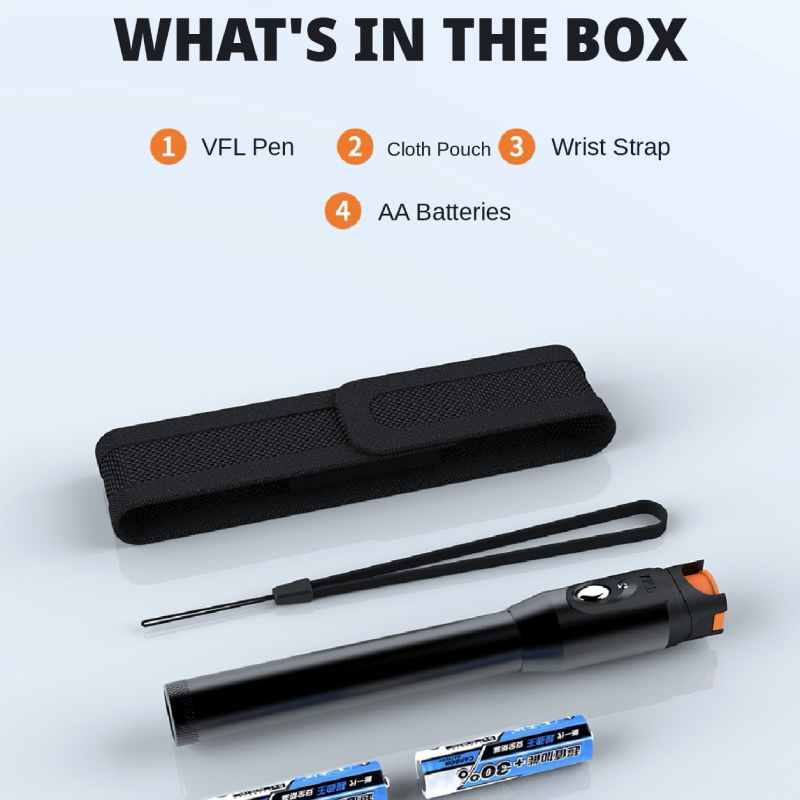
K-V30 components
- One K-V30 visual fault locator (power version as ordered)
- Cloth pouch
- Wrist strap
- 2 × AA batteries
Documents for this model
Product Catalog 2026 — this model appears in our full-range catalog (PDF), published in the Downloads center.
User manual — if you need the manual for this model now, ask via the inquiry form below or on WhatsApp and we will send the available documents with your quote.
More fiber test equipment


Questions about the K-V30
Can the K-V30 carry our own brand?
Private labeling is made to your requirements and confirmed per order — labels with your logo, part numbers and barcodes on the tools, the inner boxes and the outer cartons, ready for your warehouse. The products most often labeled are the K-35 cleaver, the KS-1 Kevlar shears and the K-870 stripper.
Can we order a small lot, unbranded?
Yes. Neutral stock is held for the core range: small lots are welcome, you can mix models in one shipment, and restock as you sell. Prices are on request — EXW factory pricing.
Ask for a quote — K-V30
Tell us the quantity, and whether you want it neutral or with your brand on it.